
When people pick a pressure scanner, the conversation usually starts in the same place: how many channels, how fast the sampling rate is, how compact the system is.
That makes sense. Those are easy to compare.
But in real wind tunnel work or propulsion testing, the specs that quietly decide whether your data is usable are often less “visible”: accuracy and range. And more importantly, how those two behave together.
It’s not a glamorous topic, but it tends to show up later in the worst possible way—when the data looks fine on paper but doesn’t line up physically.
Most pressure scanners define accuracy as ±X% FS, where FS means full scale.
That detail is easy to read past.
Because it means the error is not tied to what you are measuring. It is tied to the instrument’s full range.
Take a simple case:
A 1000 kPa pressure scanner with ±0.05% FS accuracy has a fixed absolute error of ±0.5 kPa.
That number does not change whether you are measuring 900 kPa or 50 kPa.
And that’s where things start to get less intuitive.
If you use that same 1000 kPa range in a low-speed flow field around 50 kPa, the math looks acceptable at first:
±0.5 kPa error on 50 kPa is about ±1%.
Not great, but still manageable in some cases.
But when the pressure drops further—to something like 10 kPa—the picture changes completely:
Now the same ±0.5 kPa becomes a ±5% uncertainty.
At that point, you are no longer looking at fine flow details. You are mostly looking at measurement noise with a physical label attached.
This is usually where the problem originates: one scanner range chosen “just in case,” and then used everywhere.
It feels safe at the design stage. It rarely is in actual data quality.
In practice, experienced test engineers tend to converge on a more constrained operating zone.
If a channel is working well, its operating pressure usually sits somewhere in the middle of the range—not near the top, and definitely not near the bottom.
A rough but widely used guideline is keeping normal operation within about 60–80% of full scale.
Once you start drifting below 20%, the measurement starts to lose sensitivity in a way that is hard to fix later in post-processing.
At that point, the issue is no longer calibration. It is simply that the instrument is not “looking” at the right scale.
In multi-channel systems, this becomes even more obvious. Different points in a wind tunnel rarely share the same pressure level. Forcing them into one unified range often creates more compromise than convenience.
Range selection also quietly carries a mechanical risk that is easy to underestimate.
Wind tunnel work is rarely perfectly steady. In gas turbine rigs, ignition tests, or rapidly changing aerodynamic conditions, pressure spikes can show up suddenly—sometimes well above the nominal operating level.
It is not unusual to see peaks reach 1.5 times the steady value, or more.
If the range is chosen too tightly around the expected mean, those spikes stop being “data events” and start becoming physical stress events for the sensor itself.
So in real setups, engineers usually leave a margin—often around 10–20%—not for accuracy, but simply to avoid operating at the edge of the hardware envelope all the time.
There is another factor that doesn’t show up in simple spec sheets: temperature.
Most accuracy numbers are generated under controlled lab conditions. Real test environments are not controlled in the same way.
Wind tunnel rigs, propulsion systems, and outdoor test benches all bring temperature swings that can easily reach tens of degrees.
Silicon-based pressure sensors respond to that. Even small temperature changes can introduce drift that is comparable to, or sometimes larger than, the stated accuracy.
This is why temperature compensation is no longer a “nice feature” in higher-end systems. It is what keeps the accuracy spec from becoming purely theoretical once the system leaves the lab.
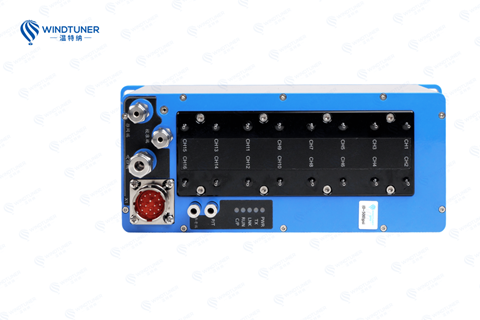
In systems like the Windtuner DAQ-P series Ethernet Intelligent Pressure Scanner, this is handled through integrated digital compensation and multi-condition drift suppression. The idea is not to make the sensor “perfect,” but to keep it stable enough that calibration in the lab still means something in the field.
Combined with traceable calibration through CNAS-certified procedures (such as JJG 875-2019 and JJF military 329-2023), the goal is to keep the measurement chain consistent from calibration to real operation, not just at the specification level.
What usually gets missed in early design work is that range is not just a capacity decision, and accuracy is not just a number on a datasheet.
They interact.
And once the system is deployed, that interaction is what defines whether the data feels clean, noisy, or quietly unreliable.
Most of the time, the issue is not that the instrument is wrong. It is that the range was never really matched to the physics of the flow in the first place.