
A manufacturer may advertise an accuracy percentage, a channel count and a sampling capability. But in an aerodynamic test, measurement quality depends on a broader chain: pressure range, temperature behavior, zero stability, channel consistency, pneumatic routing, calibration and synchronization with the rest of the test system.
This distinction becomes especially important when a pressure scanner is connected to a five-hole probe.
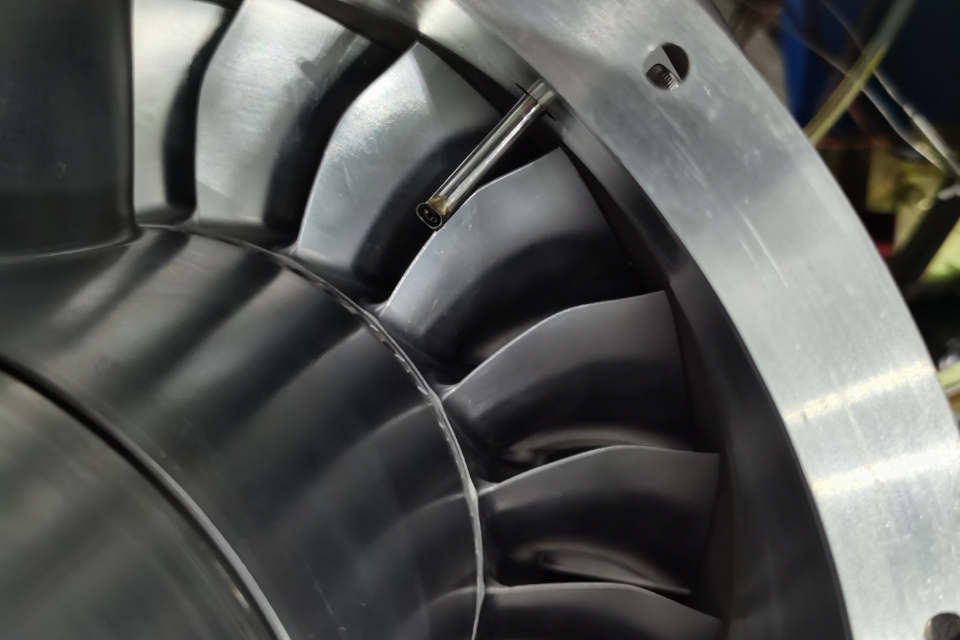
The probe determines flow direction by comparing pressures measured at different ports. NASA explains that differences between opposing openings are correlated with flow angle through experimentally established calibration curves. The five measured pressures can therefore provide pitch and yaw information, but only if the pressure differences are resolved consistently.
A small bias between channels may be of limited consequence when engineers are monitoring large absolute pressures. The same bias can become significant when an algorithm is using relatively small differential pressures to calculate flow angle. That is why pressure-scanner performance must be considered at the system level.
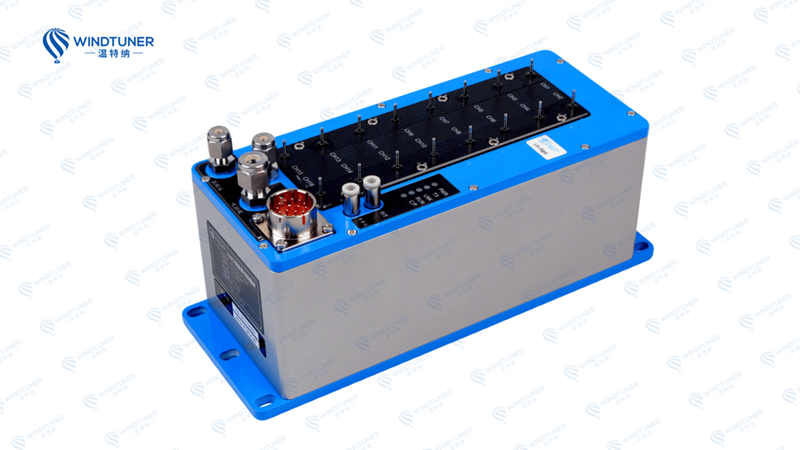
WINDTUNER’s ethernet intelligent pressure scanner provides 16 pressure channels with a stated accuracy of ±0.05% of full scale, according to the company. Its website also lists zero calibration, full-scale calibration and automatic purge functions. Each channel’s range can be customized, an approach that may help laboratories avoid specifying every channel for the largest pressure expected anywhere in the experiment.
Full-scale accuracy needs careful interpretation. If two scanners have the same percentage-of-full-scale specification but different measurement ranges, they do not necessarily deliver the same absolute uncertainty. Selecting the smallest practical range—while preserving sufficient overload margin—can improve the usefulness of the data in low-pressure applications.
Temperature is another consideration. Pressure transducers can exhibit changes in zero output and sensitivity as their temperature changes.WINDTUNER says its pressure-measurement technology includes temperature compensation and that its facilities include a full-range high- and low-temperature chamber. Buyers evaluating any scanner should ask for the applicable compensated temperature range, warm-up requirements and uncertainty documentation rather than relying on a room-temperature accuracy figure alone.
Pneumatic integrity is equally important. Moisture, particles or residue in a pressure line can obstruct a port or alter its response. A purge mode can help clear tubing, although the purge pressure and procedure must be compatible with the probe and test article. Leakage checks and disciplined tube identification remain essential.
Response time is influenced by more than electronics. Tube length, internal diameter, cavity volume and the properties of the measured gas form a pneumatic system that can attenuate or delay pressure changes. Placing a scanner closer to the measurement point can improve pneumatic response, but may expose the instrument to heat, vibration or limited installation space.
Then there is synchronization. In a traversing experiment, a technically accurate pressure value can still be unusable if it is associated with the wrong probe position.WINDTUNERsays its measurement architecture can work with electric displacement mechanisms, motion controllers and WindLabX software to coordinate movement and acquisition. The practical objective is to establish when the probe has reached a location, when the pressure has settled and which readings belong to that point.
Calibration provides the final layer of confidence.WINDTUNER states that its testing center is recognized by the China National Accreditation Service for Conformity Assessment and includes low-speed, subsonic and supersonic wind-tunnel laboratories. Its website says pressure-scanner calibration is performed with reference to JJG 875-2019 and JJF (Military) 329-2023. International buyers should examine the certificate’s scope, reported uncertainty and traceability to decide whether it satisfies their own quality system.
For procurement teams, the right questions go beyond “What is the accuracy?” They include the range assigned to each channel; whether the specification is based on full scale or measured value; how zero drift and temperature effects are handled; what calibration uncertainty is reported; how the pneumatic configuration affects settling time; how timestamps and position data are synchronized; and whether the scanner can be verified before and after a campaign.
An intelligent pressure scanner is not intelligent merely because it has Ethernet connectivity or software. Its real value lies in controlling sources of uncertainty and making those controls repeatable. In high-value aerodynamic testing, that discipline determines whether a pressure map is simply attractive—or technically defensible.