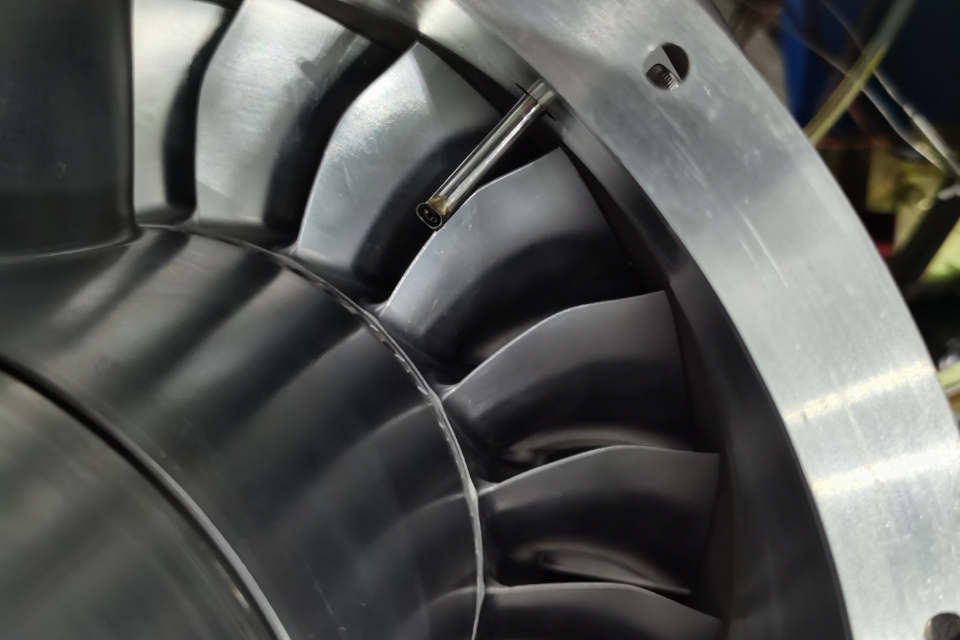

A five-hole probe is a type of multi-hole probe. By measuring pressure signals from five individual ports, it can reconstruct the total pressure, static pressure, flow velocity magnitude, and flow direction into a three-dimensional flow field.
The fundamental logic of a five-hole probe is based on flow-around effects. When airflow passes around an object, the velocity distribution over its surface changes, and the pressure distribution changes accordingly. The pressure on the windward side is high, while the pressure on the side and leeward regions is lower.
Take the simplest shape—a sphere—as an example, the pressure distribution on the surface of a sphere placed in a uniform flow is shown in the figure below.

If we set a small pressure port at the stagnation point on the windward side(the left side of the graph) of the sphere, the pressure measured by the pressure scanner corresponds to the total pressure of the incoming flow.
However, we will meet many issues if we directly follow this method. In many practical situations, not only do we not know the magnitude of the incoming velocity, we also only have an approximate knowledge of the flow direction. The measured pressure only equals the true total pressure when the probe is perfectly aligned with the incoming flow. Note that when a yaw or pitch angle exists, the measured pressure becomes lower than the total pressure.
One solution to prevent this is to make the pressure signal at the windward port insensitive to flow angle, so that even with a certain misalignment, the measured pressure remains very close to the total pressure. This is the principle behind the airspeed probe (Pitot tube). The figure below shows several Pitot tube geometries and how their measured pressure varies with flow angle.

As shown in the figure, when aligned with the flow, all Pitot tube designs measure the total pressure. When a flow angle exists, the airflow near the probe tip is no longer fully stagnated, and the measured pressure becomes slightly lower than the true total pressure. Different nose geometries have different angular sensitivities, but generally, within a range of ±10°, the measured pressure still closely represents the total pressure.
However, if the flow direction also needs to be determined, a Pitot tube is no longer sufficient. In this case, multi-hole probes are required.
Three-Hole Probe and Two-Dimensional Flow Measurement
Our first solution for this is the two-dimensional case. As shown in the figure below, three pressure ports are opened on the windward side of a cylindrical probe head. Hole 1 is located at the center, while Holes 2 and 3 are positioned symmetrically at ±30°.
When Hole 1 faces the incoming flow, it measures the total pressure. Holes 2 and 3 measure the static pressure, since for ideal flow around a cylinder, the surface pressure at ±30° equals the free-stream static pressure. With these three pressure measurements, both total pressure and static pressure are available, allowing the flow velocity to be calculated.

If the incoming flow direction is unknown, how do we align Hole 1 with the flow? The first way is to rotate the probe and assume that alignment occurs when the pressure measured by Hole 1 reaches its maximum. However, this method is inaccurate because within a few degrees of alignment, the pressure variation at Hole 1 is very small.
A even better method yet, is to rotate the probe. The moment the pressures measured by Holes 2 and 3 are equal, we know that Hole 1 is facing the flow. The flaw of this method is while it works in principle, it requires repeated probe rotation during measurement and is therefore inconvenient. In reality, Holes 2 and 3 may never perfectly symmetrize because of various imperfections, so equal pressures do not necessarily guarantee exact alignment.
This next approach avoids the need for precise alignment altogether. As long as the probe is approximately oriented toward the flow, the allowable misalignment can reach 30° to 60°, depending on the probe design. By recording the pressure outputs from the three holes, we can find the mathematical relationship between the change of pressure and flow angle, allowing the flow angle to be calculated directly. This method is known as the non-nulling method, while the previous methods are referred to as nulling methods.
Below is the definition for a pressure-based angular coefficient:


The denominator in this expression varies very little within a certain angular range, and it is always positive, so the angular coefficient is mainly determined by changes in the numerator. For example, the following two cases correspond to negative and positive angular coefficients, respectively.
Negative Angular Coefficient

Positive Angular Coefficient
In theory, if we know the relationship between the angular coefficient and flow angle, we can use the measured pressure data to calculate the angle of flow. However, this method isn’t always applicable because of the instability of actual flows. That's why actual probes must undergo calibration. By measuring pressure signals at known flow angles and fitting the data into calibration curves, the flow angle and velocity can be reconstructed during measurements.
If the probe is completely misaligned with the windward side, no valid velocity data can be collected. In this case, some pressure ports are faced towards not a consistent flow, but towards separated flow regions, making the pressure response no longer monotonic. No clear relationship exists between them now.
Five-Hole Probes for Three-Dimensional Flow
Our analysis above described how three-hole probes work in two-dimensional flow measurement. The same principle basically applies to five-hole probes in three-dimensional flow fields, with airflow around a three-dimensional body.
Five-hole probes can have spherical, conical, or pyramidal probe heads, each with its own advantages and limitations. Conical designs are most commonly used. This figure below is a reference diagram of five-hole and seven-hole probes.
Five-hole and seven-hole probes essentially share the same properties. In theory, more pressure ports means expanded measurable angular range, but this of course greatly depends on probe design and data-processing methods.
Windtuner’s Capability in Five-Hole Probe Manufacturing
Windtuner stands strong and capable in the global five-hole probe manufacturing field. We are professional and experienced in the entire process including probe design, manufacturing and calibration services. For clients with specific requirements, Windtuner’s aerodynamic expert team can design various customized five-hole probes. To date, Windtuner has manufactured more than 60,000 probes of various types and has earned wide recognition from research institutes and industrial clients.