
Full Scale Changes the Error Budget
The FS(Full Scale) indicator matters when it comes to pressure measurement capability-the ±0.05% FS accuracy class sets an absolute error band from the selected full scale. If two pressure scanners have the same accuracy class, but one has a much wider range, the wider-range unit also has a larger absolute error limit. That may be acceptable for a high-pressure engine station. However it can be a poor fit for a low-speed wake survey where the useful differential pressure is small, so the ideal selection of a pressure scanner depends on the actual circumstances in which it would be used.Engineers sometimes compare pressure scanners by percentage alone. The better comparison starts with the smallest pressure change the test must resolve. That value comes from the aerodynamic question: a pressure coefficient change on a wing, a loss across a cascade, a fan outlet nonuniformity, or an inlet distortion pattern. Once the expected signal is estimated, the full-scale error can be expressed in the same pressure units and placed directly in the test uncertainty budget.
Too Much Range Hides Useful Detail
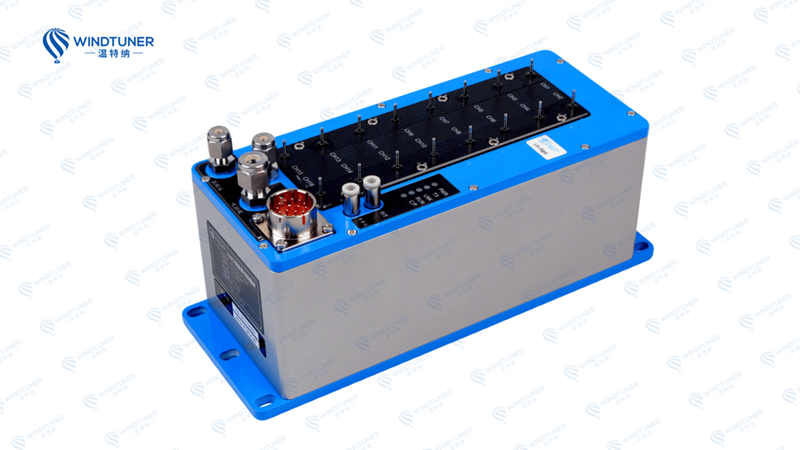
A range chosen for the largest pressure value anywhere on the rig may waste measurement capability on most channels. One port might see a high total pressure while nearby static taps measure much smaller differences. Putting every channel on the broadest range simplifies purchasing, but it can make the low-level channels less informative. The pressure scanner continues to produce stable digital values; the issue is whether those values separate the changes the engineer needs to see.WINDTUNER pressure scanners use 24-bit A/D resolution and deliver sampling rates adjustable up to 500 Hz. Digital resolution and sampling speed do not cancel a mismatched pressure range. More counts cannot change the full-scale accuracy class, and faster samples cannot recover detail that sits below the useful error band. Range selection has to come before the test team decides how much data to collect.
Too Little Range Leaves No Room for the Test
Choosing the narrowest possible range, on the other hand, creates a different problem. Startup conditions, model changes, valve switching, or an unexpected flow separation can push pressure beyond the planned steady-state value. If the channels on the multi-channel pressure scanner exceed their configured ranges during the test, they lose effect and the test may fail or need to be redone.A sound range plan includes margin for known operating changes without treating every unlikely event as the design point. WINDTUNER pressure scanners support software, hardware, and timed triggers, so teams can coordinate acquisition with the test sequence. The same planning step should identify normal(or differential, atmospheric) pressure, expected peaks, and the channels most exposed to transients. Those channels may need a different range from the rest of the rig.
Modular Range Planning Follows the Pressure Channels
Each WINDTUNER pressure scanner unit provides 16 channels and supports TCP/IP or UDP communication. A test can group channels by pressure level instead of forcing one range philosophy across the whole measurement system. Low differential pressures can stay with a range selected for detail, while higher-pressure stations use suitable modules. IEEE 1588V2 keeps distributed units on one time base when the channel groups operate together.This architecture also gives the test program room to change. Early component work may use one 16-channel unit. A later rig can add channels for more taps or another pressure level without replacing the original acquisition structure. WindLabX measurement and control software manages device settings and acquisition tasks, keeping the selected ranges with the channel configuration used for the run.
Pressure scanner range selection should end with a number the test engineer can defend: expected signal, absolute full-scale error, transient margin, and the channel group assigned to that range. WINDTUNER pressure scanners deliver ±0.05% FS accuracy, but the pressure range selected for the test determines the absolute error that this specification represents. The scanner configuration can be easily configured to the measurement before the first run, so clients can start acquitting useful pressure data detail without sacrificing operating headroom.